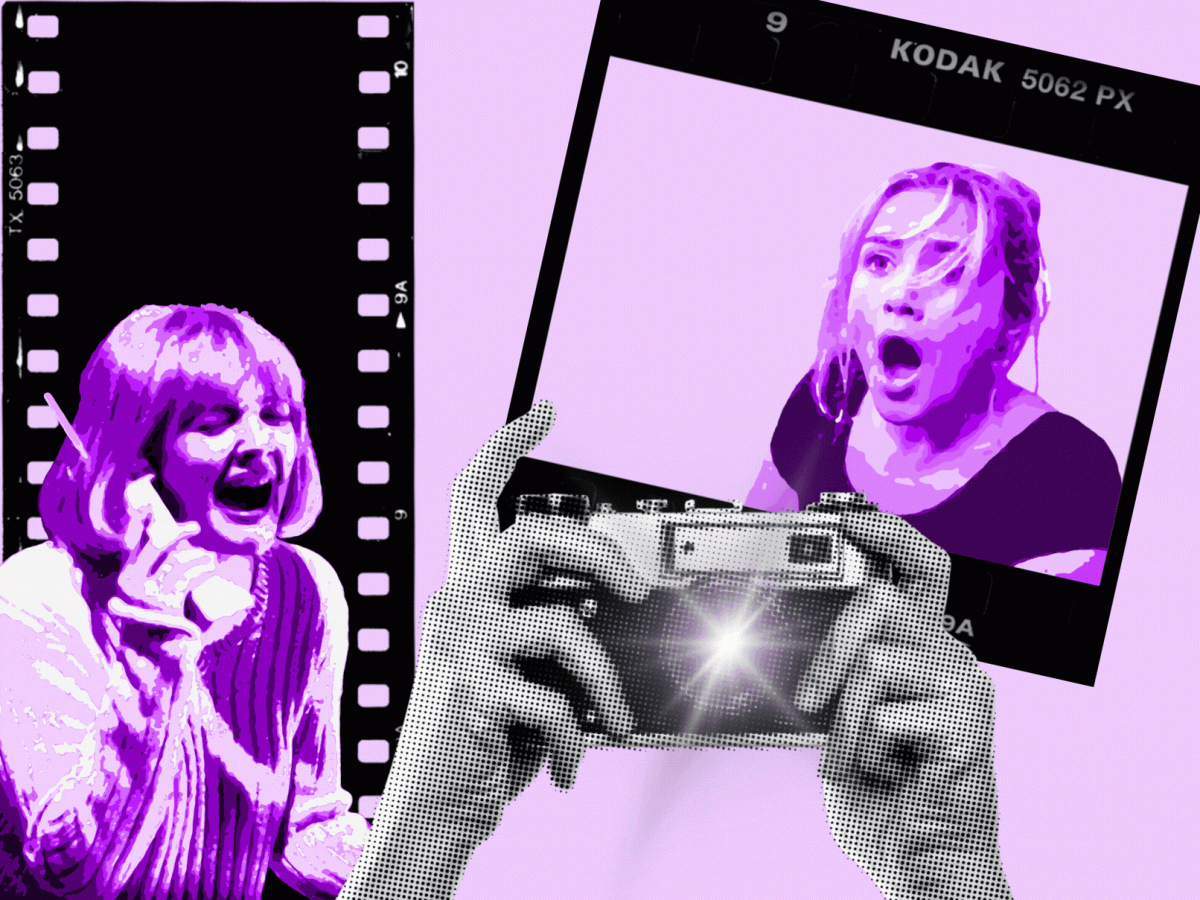


“One of the striking characteristics of the new mass media — radio, television, and the movies — is that they give the illusion of face-to-face relationship with the performer,” sociologists Donald Horton and Richard Wohl said in the 1956 essay, “Mass Communication and Para-Social Interactions: Observations on Intimacy at a Distance.”
Today, the rise of social media platforms has expanded celebrity-fan interactions beyond traditional mass media consumption. Prior to social media, fans had no access to celebrities outside of books, movies, televised interviews and other such media. This changed with platforms like Instagram, Facebook and TikTok, which gave fans insight into the everyday lives of celebrities.
The term parasocial relationship was first coined in the aforementioned essay by Horton and Wohl to refer to the one-sided relationships between viewers and media figures. But in the digital age, this term has proven more relevant than ever. In addition to making information about public figures accessible, social media platforms have given rise to a new genre of public figures: influencers.
The one-sided nature of parasocial relationships stems from the fact that the bond between a viewer and media figure exists only in the viewer’s mind.
Social media platforms allow individuals to engage with content from public figures, and with increased engagement comes increased feelings of connection.
For instance, the 2024 research article “The Impact of Following Duration on the Perception of Influencers and Their Persuasive Effectiveness Explained by Parasocial Relationship Stages,” found that when individuals follow influencers for longer periods of time they experience heightened parasocial interaction.
Considering that 90%, 63% and 61% of U.S. teens use YouTube, TikTok and Instagram, respectively — according to the 2024 Teens and Social Media Fact Sheet by Pew Research Center — teens are particularly prone to the development of parasocial relationships.
This is corroborated by the 2017 research article “Parasocial Interactions and Relationships in Early Adolescence.” The mean age of participating adolescents was 15 and 61% of adolescents reported thinking of their favorite media figures as relationship partners. Further, those who reported thinking this way also reported more parasocial involvement and emotional intensity than those who did not.
Vulnerability and Authenticity Online
As Horton and Wohl noted in 1956, parasocial relationships provide the “illusion of intimacy,” and this illusion still exists today. In fact, a contributing factor to parasocial relationships is the recent push for media figures to be more vulnerable and authentic online.
“People so badly wanted me to be authentic, and when that happened, finally, it was a huge release,” Selena Gomez said in an interview with Vogue in 2017. “I’m not different from what I put out there. I’ve been very vulnerable with my fans and sometimes I say things I shouldn’t. But I have to be honest with them. I feel that’s a huge part of why I’m where I am.”
Audiences value content that seems genuine; when celebrities and influencers share personal stories and struggles it resonates more with viewers. Thus, being authentic fosters engagement.
Being open online permits influencers and celebrities to forge deeper connections with audiences, allowing for increased viewer loyalty and greater engagement. However, public figures may also be vulnerable online for strategic reasons, sharing emotional moments to intentionally generate empathy, as empathy generates profit.
When influencers and celebrities partake in brand deals or promote products online, a lot of the appeal comes from the public figure’s perceived authenticity. Those chosen to promote products are trusted by their audiences because their content is seen as vulnerable and truthful.
According to the article “What Makes a Successful Celebrity Brand?” published by the Harvard Business Review, “Celebrities shifting from simple endorsement deals to influencer deals must be able to attract millions of followers, create engaging content, mix day-to-day (unpaid) posts with promotional messaging, and recommend the brand in ways that feel unscripted and authentic. Because this work entails higher-order skills and sustained daily effort, brands richly compensate celebrity influencers.”
Consequently, influencers and celebrities benefit from producing authentic and vulnerable content — content that encourages the development of parasocial relationships.
Due to the demand for vulnerability, it has also become increasingly common for public figures to share their mental health struggles online. In doing so, they are generating awareness, reducing stigma, and creating a space for open dialogue.
Selena Gomez, for example, has been one of the most prominent advocates for celebrity vulnerability and has been sharing her experiences with lupus, bipolar disorder, anxiety and psychosis for quite some time. Public figures from Prince Harry to Billie Eilish to Megan Fox have been vocal about their mental health struggles, normalizing such conversations.
To have a parasocial relationship with a celebrity who is vulnerable about their mental health struggles can thus positively influence individuals’ perceptions of mental health conditions. A 2022 study of more than 300 people between 18 and 35 published in Scientific Reports, titled “Parasocial relationships on YouTube reduce prejudice towards mental health conditions,” found that parasocial relationships might help lessen the stigma surrounding mental health conditions.
Loneliness
Another prevalent factor in the development of parasocial relationships is loneliness, which was exacerbated by the social isolation brought on by COVID-19. During the pandemic’s deficit of face-to-face interactions, social media platforms allowed for the formation of parasocial interactions.
For years, family and friends were not physically present in people’s lives, but the human desire for connection remained. Social media platforms kept public figures visible amidst the isolation, offering connection and comfort.
COVID-19 may have put up a barrier between individuals and the people in their lives, but it did not put up a barrier between individuals and the public figures’ they follow.
The 2022 study “Parasocial relationships as functional social alternatives during pandemic-induced social distancing,” published by the American Psychological Association, supports this notion, finding that rates of parasocial relationships increased during COVID-19 as a means of combatting feelings of isolation.
Even if parasocial relationships are not developed to explicitly reduce feelings of loneliness, they reflect the human need for social interaction. Post-pandemic, there persists an environment in which people increasingly spend their time online and on social media.
Scrolling cannot satisfy the need for more social interaction, though, hence parasocial relationships. If people are not seeing and engaging with others’ in person, then they will be more inclined to develop bonds with those they see and engage with online.
According to the article “Parasocial Relationships” published by Psychology Today, “Some research suggests that the lonelier an individual feels, the more likely they are to engage in parasocial relationships, seeking a connection in some form, if not in real life.”
For marginalized groups in particular, parasocial relationships with individuals who share a group’s identity can make them feel less alone and more represented.
Having a parasocial relationship with a public figure can also connect someone with others who share a similar admiration for this person. In this way, people can build community via parasocial relationships, thereby reducing loneliness.
The relationship Taylor Swift fans have with the singer, and thus with each other, exemplifies the phenomenon.
Swift has cultivated a dedicated fanbase with a shared identity, a concept that comes from social identity theory. According to this theory, a significant part of one’s self-concept comes from the groups they belong to. For some of Swift’s fans, her music is more than a source of enjoyment; it is part of who they are as people.
“You’ve created traditions. You’ve created this mass movement of joy everytime we play a show and it makes me so proud. It really does,” Swift said in a video posted on X, formerly Twitter. “Like I just showed up one day and you guys were creating friendship bracelets…”
Effects
When parasocial relationships first became topics of conversation they were generally considered unhealthy. Yet, since then, research has proven that these relationships can have both negative and positive consequences depending on the intensity and nature of the perceived relationships.
In 2006, researchers David Giles and John Maltby classified parasocial relationships in three subcategories, namely entertainment-social, intense-personal and borderline-pathological. These subcategories reflect the different intensities of parasocial relationships, or more specifically, the levels of control individuals have over their feelings in parasocial relationships.
Most parasocial relationships, according to Giles and Maltby, fall into the entertainment-social subcategory. In such relationships, people are aware of the fact that they do not actually know public figures, even though it feels like they do.
Parasocial relationships of the entertainment-social nature have positive effects. It is when they grow to be of the intense-personal nature that negative consequences can more outwardly be seen and when they are of the borderline-pathological nature that they can be dangerous.
Giles and Maltby described intense-personal parasocial relationships as reflective of “intensive and compulsive feelings about the celebrity.”
Those engaging in such relationships still understand that the bond between them and a public figure is not real, but they also lack complete control over their feelings toward that figure.
Then, there is the most dangerous form of parasocial relationships: borderline-pathological. These are the least common type of parasocial relationship and are defined by a lack of control over one’s feelings, thoughts and even behavior in some cases.
On the beneficial side of things, parasocial relationships can provide people with positive role models.
Social learning theory, developed by Albert Bandura, posits that people learn by observing others. Observational learning is a key aspect of social learning theory and occurs when people model their behavior off of others. One type of mode is the symbolic model, or learning via media, including social media, books, TV and more.
Bandura’s research revealed that people are more likely to imitate behaviors when the model, for one, holds a high-status position. This includes singers, athletes, leaders, other celebrities and individuals who are successful in their fields.
Therefore, if someone follows a celebrity who lives a healthy, active, eco-friendly, charitable or otherwise positive lifestyle, they may be more inclined to emulate that lifestyle and be healthy, active, eco-friendly or charitable themselves.
Still, there are also consequences that come with parasocial relationships.
Parasocial relationships are above all one-sided — substitutes for genuine connection. So, if engaged in too intensely, they can isolate or cause people to withdraw from real-life social networks. This then has the effect of exacerbating loneliness.
Loneliness and isolation are linked to increased risks of chronic and mental health problems, including depressions, anxiety, heart disease and dementia.
Parasocial relationships can also compel people to defend celebrities against criticisms by making such critiques feel like personal attacks.
Another psychological factor at play is cognitive dissonance, which occurs when people hold two conflicting beliefs, attitudes or behaviors.
When a celebrity’s harmful actions come to light, a fan is forced to reconcile their positive view of the celebrity with the new and not positive truth. To resolve the discomfort created by holding these two conflicting beliefs, fans may rationalize a celebrity’s behavior or attempt to minimize it.
The 2022 University of Cambridge study “Followers Forever: Prior Commitment Predicts Post-Scandal Support of a Social Media Celebrity,” analyzed 36,464 posters of Logan Paul’s YouTube page prior to and after the incident in which he mocked people who committed suicide. Seventy-seven percent of users who had left comments before the scandal continued to support him after it and users known to frequently comment positively on his videos were 12% more likely to keep supporting him publicly.
When celebrity defense becomes excessive, people begin to overlook or excuse public figures’ misconduct, creating an environment in which real offenses are normalized and justified.
Further, the negatives of parasocial relationships extend to public figures as well. Social media has effectively blurred the line between celebrities’ personal and public lives. The illusion of a bond created by parasocial relationships makes fans feel entitled to know the details of celebrities’ personal lives.
“I don’t think that people, just because they have this job, that every aspect of their life should be watched and written about. We haven’t signed up for a reality TV show,” actress Florence Pugh said in a 2022 interview with Harper’s Bazaar.
This belief has led some fans to invade the privacy of the very celebrities they idolize. Fans have gone door-to-door asking for directions to Drew Barrymore’s home, camped outside Shawn Mendes and Camila Cabello’s house and dug up and shared Doja Cat’s private family information online.
Consequently, there has been no shortage of celebrities calling out the invasive behavior of fans. One of the more infamous examples is Chappell Roan’s statement on the matter, which she posted to Instagram on Aug. 23, 2024.
“I do not accept harassment of any kind because I chose this path, nor do I deserve it,” Roan said. “…I don’t agree with the notion that I owe a mutual exchange of energy, time, or attention to people I do not know, do not trust, or who creep me out — just because they’re expressing admiration.”
Evidently, the implications of parasocial relationships are vast for both those engaging in the relationships and for the celebrities who are the subjects of the relationships.
Conclusion
The digital age has shaped the existence of parasocial relationships today, but as social media platforms expand and Artificial Intelligence evolves, these relationships will only continue adapting with the times. Their implications will shape mental health and celebrity culture in new ways, while simultaneously bringing questions about privacy to the forefront of conversations regarding social media and life online.
This story was originally published in the January 2026 Eagle Eye print edition.






![National Honor Society Sponsor Lauren Saccomanno watches guest speaker Albert Price speak to NHS members. National Honor Society held their monthly meeting with Price on Monday, Nov. 4. "[Volunteering] varies on the years and the month, but we have started a couple new things; one of our officers Grace started a soccer program," Saccomanno said. "We have been able to continue older programs, too, like tutoring at Riverglades. NHS's goal is to have as many service projects as possible."](https://eagleeye.news/wp-content/uploads/2024/11/xNOeKNVwu7aErpVyJHrHogagZUUcLLosjtbIat94-1200x900.jpg)
![Ice Ice Baby. Skating to "Waltz" and "Romance" during her long program, figure skater Ava Zubik competes at the Cranberry Open in Massachusetts on Aug. 12, 2022. She scored a total of 86.90 on her short and free skate program, earning fifth place overall. "I try to make it [competing] as fun and enjoyable as I can because it's my senior year, and so I want to really enjoy competitive figure skating while it lasts," Zubik said.](https://eagleeye.news/wp-content/uploads/2024/11/skater1-799x1200.jpg)