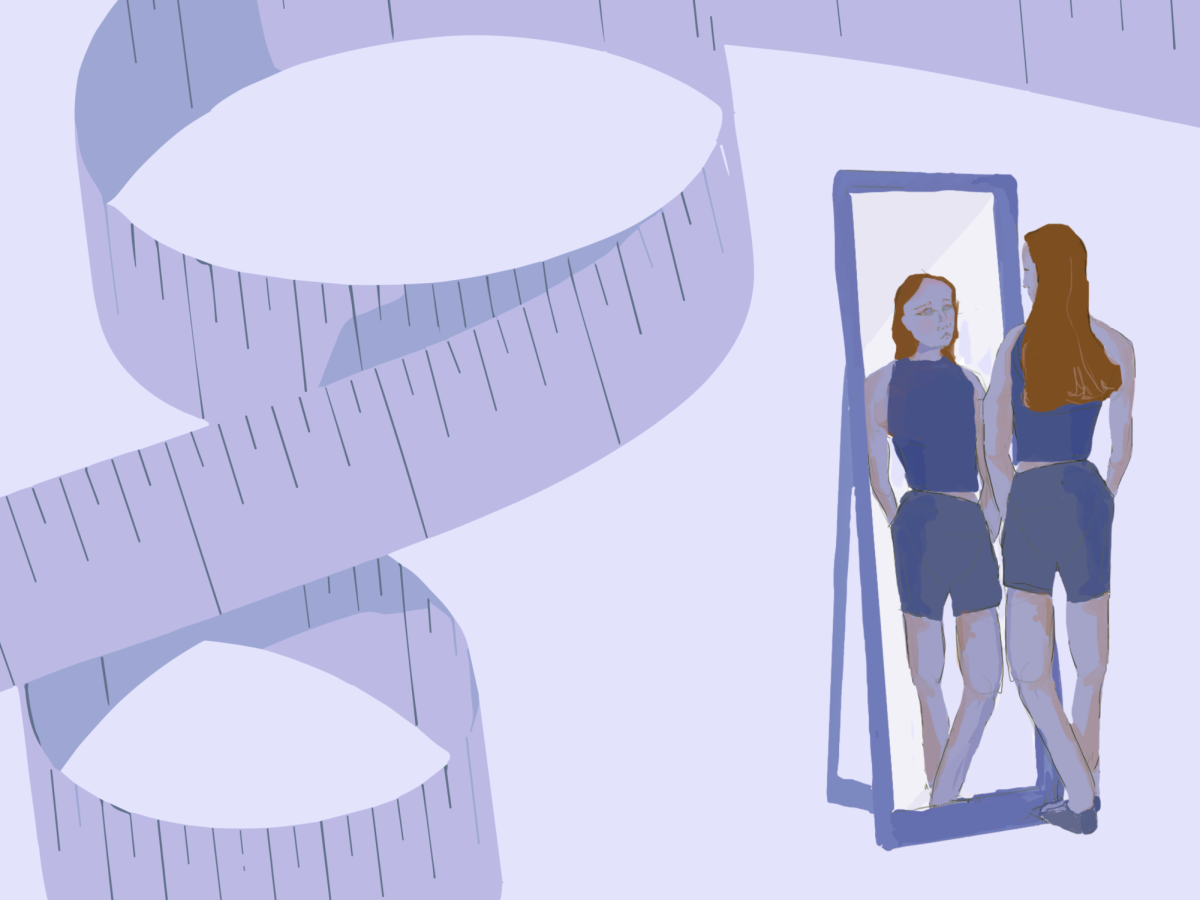


A teenage girl’s face is illuminated by Instagram, liking posts of curated photos. She lingers on one image in particular: a woman showing off her body, with the caption noting the amount of weight she has lost. The teenager opens the comments out of curiosity, each one praising the woman for being thin. She then sighs, turns off her phone and looks in the mirror, disappointed by what she sees.
This situation is not specific to her; 89% of social media users experience these silent comparisons and internal judgements every day, according to the 2023 article “Comparison Culture” by the Cybersmile Foundation.
As the use of social media increased, people began to post their bodies and workout routines online. While this is not a problem on its own, comments praising creators for having a certain “look” have become a prominent issue online.
Thus, what may have once been harmless posts have evolved into complex webs of validation, self doubt and unrealistic ideals.
Changing Trends
With the rise of social media platforms like Instagram, TikTok and Snapchat, the visibility of others’ bodies has never been higher. Content creators and influencers frequently share gym routines, diet plans and transformation photos on these apps, often with the intention of inspiring others.
However, on social media there is an underlying pattern of praise and validation that rewards a narrow standard of beauty.
Alongside social media content is an everchanging chain of beauty trends. Phrases such as “Instagram model,” “headphone waist” and “legging legs” are commonly used to denote a specific type of appearance: toned limbs, curves, a tiny waist, smooth skin and long legs — features that are difficult to attain for the average person. Consequently, these phrases promote unrealistic beauty standards.
“It sets really unrealistic expectations for women because everybody looks different,” sophomore Valentina Correa said. “Sometimes you can’t even really change that about yourself, and even if you could, you could kill yourself trying.”
Changing beauty standards can also be seen through filters. Filters that change a person’s face or body to look “better” are created and used by millions of people daily. With this modern technology, altering one’s appearance has become easier than ever. Apps come with built-in filters that can sharpen a jawline, brighten skin, slim a waist or change a nose shape.
Further, many creators digitally edit their bodies before posting them on social media, subtly or dramatically reshaping themselves. The normalization of distorted appearances manipulates reality, setting up an impossible comparison for users.
Another trend that has recently risen in popularity, particularly among young men, is “looksmaxxing.” This trend involves practices aimed at improving one’s physical appearance through methods such as skincare regimens, jawline exercises and even minor cosmetic procedures, all performed with the intent of boosting social appeal and confidence.
“Social media sets unrealistic expectations of what guys should look like, especially at our age right now,” senior Robert Meis said. “People should just be glad for what they have rather than what they could have.”

Looksmaxxing has grown significantly in the past few years due to the potential profits from promoting it. According to Shopify’s article “Influencer Pricing: The Costs of Influencers in 2025,” many companies pay influencers significant amounts and those influencers can receive anywhere from $10-$10,000 to promote their products intended for looksmaxxing.
One specific example is mewing, a technique that involves placing the tongue on the roof of the mouth. This is believed to help reshape the jawline and improve health aspects, such as sleep and mouth breathing. Mouth tape, or breathable tape intended to keep one’s mouth closed while sleeping, is promoted on social media by influencers to assist with mewing.
“[Mewing] influences [them] to feel peer pressured to do actions that might make [them] feel more self-conscious about [themselves] as a person,” junior Isaac Lam said.
Currently, no scientific evidence exists that supports the alleged benefits of mewing. A 2025 study titled “When Help is Harm: Health, Lookism and Self-Improvement in the Manosphere” published by the National Library of Medicine stated, “… the community engages in masculine demoralisation of users, situating their manhood and lives as flawed because of their appearance.”
A 2024 BBC article titled “Inside looksmaxxing, the extreme cosmetic social media trend” featured Dr. Stuart Murray, the director of the Eating Disorders Program at the University of Southern California.
“It’s really shocking,” Murray said. “The TikTok stuff out there is not evidence-based, but it’s reported as science. If we fall into the trap of dissatisfaction and low self-esteem, if you’re diluting yourself down to a number or a skin tone, or an angular tilt of your face, it reduces your value as a person.”
The Search for Validation
Much of these trends and behaviors stem from one thing: social validation. People crave approval from their fellow content creators in the form of engagement: likes, followers and comments.
A 2024 study posted in the Asia Pacific Management Review, titled “Authenticity meets aesthetics as the Equalizer for virtual and human influencers,” mentions that posts from conventionally attractive users often receive higher, more positive engagement.
Conversely, users who do not fit these ideals often receive fewer likes or even hateful comments, as shown by a 2022 study named “Psychosocial Determinants of Adolescents’ Cyberbullying Involvement — The Role of Body Satisfaction” published in the International Journal of Environmental Research and Public Health.
Likes and comments may seem harmless, but for many, they become the only form of positive feedback that they receive. This pressure to keep up with others contributes to a constant need for validation and a fear of missing key social or cultural events, according to a 2025 article by Unicaf called “The Psychology of Social Media: How Platforms Shape Human Behavior.”
What is more harmful is the fact that this validation is often short-lived. The dopamine rush from receiving positive engagement fades quickly, and the need for more grows stronger.
According to a 2024 article from Global English Editing, people who rely on social media for validation often post excessively, over-emphasize their life, neglect real-life connections and overreact to criticism.
In the long term, this system of attention-seeking behavior can lead to emotional exhaustion, physical health issues and mental health conditions.
Effects of Harmful Trends
These online patterns have very real consequences. This dissatisfaction can spiral into mental health conditions like body dysmorphia, a condition in which one has an overwhelming negative preoccupation with their physical appearance. People with dysmorphia may spend hours in front of mirrors, repeatedly check their appearance in photos or avoid social gatherings altogether, as reported by the National Health Service. If not taken care of, dysmorphia can lead to even more dangerous habits like eating disorders.
“I’m sure everybody’s experienced body dysmorphia at some point in their lives, whether it be from not being swole enough after working out at the gym or not feeling skinny enough,” junior Isabella Hogan said. “It makes you feel bad about yourself even if you’re completely healthy and may even make you feel like you have to do unhealthy things to achieve a certain look.”
One of the most common disorders is anorexia nervosa. This disorder is characterized by weight loss and difficulties maintaining a healthy weight. People with anorexia restrict the number of calories and types of food they eat. Some people with the disorder may also exercise compulsively, purge and binge eat.
These disorders can lead to other health conditions. Eating disorders can result in heart problems, hormonal imbalances and in some cases, death. A 2020 study titled “Review of the burden of eating disorders: mortality, disability, costs, quality of life, and family burden,” published in the Current Opinion in Psychiatry, states that over 3.3 million lives are lost annually because of eating disorders. Mental conditions are also present in those with eating disorders.
“Pro-ana” Content and “#Skinnytok”
Many with anorexia nervosa find homes in online communities making “pro-ana” content. Pro-ana content promotes and normalizes anorexia. The communities also glamorize 2000s diet culture, a time known for significant restrictions on foods and abnormal diet trends. Countless of these posts feature “thinspo”— pictures or videos of extremely thin women that aim to inspire others to alter their body to look like the posts.
These communities can be extremely destructive to users because members encourage negative eating habits and other destructive behaviors. For instance, according to a 2024 study titled “#ForYou? the impact of pro-ana TikTok content on body image dissatisfaction and internalisation of societal beauty standards,” posted by PLOS ONE, women exposed to pro-ana content suffered a significant decrease in body image satisfaction.
On the other hand, pro-ana communities online take body positivity posts and use them as “fatspo.” Fatspo is pictures or videos displaying fat people in a trivializing way, often used to encourage others not to binge or eat in general to avoid becoming overweight. They exaggerate the way normal meals affect the body and target normal posts.
Body positivity influencers often respond back by calling them out. For instance, after having one of her posts targeted as fatspo, self-love influencer Dani Fernandez responded by saying, “I know you got problems at home but you don’t need to project them to us.”

These body standards and terms are heavily prevalent on “#skinnytok,” or a side of TikTok where influencers promoted disordered eating and unhealthy weight loss. After pressure by European regulators, the hashtag was banned in early 2025.
Popular skinnytok influencer Liv Schmidt was banned from TikTok in September 2024, and her Instagram account where she ran her group “Skinni Societe” was demonetized earlier this year. In the group, she often posted phrases such as “You’re not restricting. You’re ‘regulating.’ It’s chic.”
“I think it’s terrible,” English teacher Donna DeStefano said. “I think it [sets] unrealistic expectations. I don’t think it considers athletic bodies.”
Female athletes and gym rats also face hatred by skinnytok influencers. The gym influencer known online as Elloise Fit, has had her content posted on Skinnytok before, in which they criticized her and commented negative things towards her body.
Social media apps can fix these issues by moderating pro-ana and skinnytok content to stop spreading it or stop pushing it to minors. However, this proves to be difficult as many who promote such content replace or swap letters with numbers or symbols in banned hashtags to keep spreading content.
The Rise of Body Positivity
Despite all of the negative influences, there is a growing movement to regain control over body image. In fact, many body positivity movements have risen on social media. These movements encourage people to embrace their bodies as they are, not as social media claims they should be. Instead of contributing to the harmful trends on social media, content creators are posting videos focused on self-love, acceptance and inclusion.
“The rising trend of self love and body positivity on social media is so great because it promotes healthy bodies and not trying to live up to unrealistic standards,” junior Lucy Woo said.
This shift has also influenced company operations. Brands are being held accountable for limited size ranges, use of filters and retouching. Consumers are demanding inclusive products, diverse models and honest marketing. While not all companies have fully embraced this change, many stores, both physical and digital, have expanded their product lines to accommodate all types of people. For example, many consumers have noticed a shift towards larger sizes for Brandy Melville, a store that has faced criticism in the past as their clothes have typically catered to thinner people.
Along with clothing stores, people are calling out any filters or editing present in social media posts. More people are unfollowing influencers who promote unrealistic body standards and are turning to genuine creators; being “real” is becoming more valuable than being “perfect.”
As social media continues to shape how people present themselves and perceive others, its influence on body image remains complex. While some find community through body-positive movements, others struggle with the pressure to conform and accept unrealistic standards. The discourse over body image continues to evolve. As social media grows, awareness can be spread to promote healthier online experiences.
This story was originally published in the January 2026 Eagle Eye print edition.