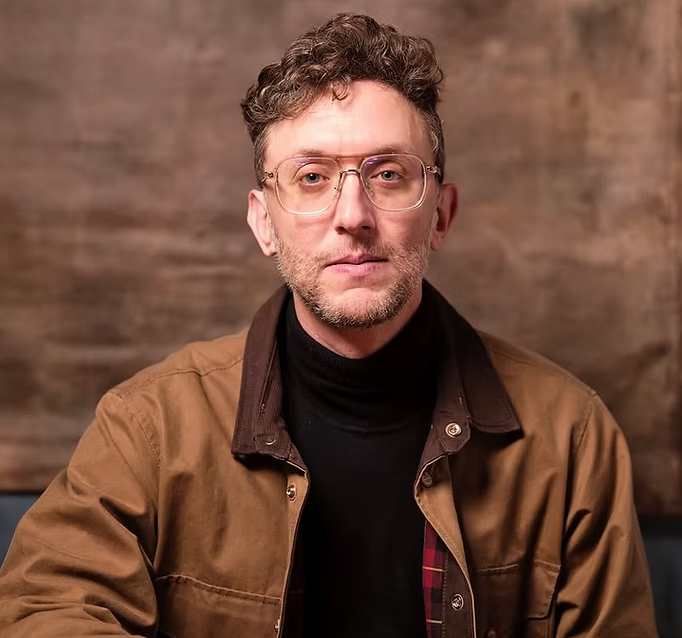

David Borenstein is a filmmaker. With the help of his co-director, Pavel “Pasha” Talankin, he created the Oscar-winning documentary “Mr Nobody Against Putin,” filmed in School No. 1 in Karabash, an elementary school where Russian propaganda was introduced during the Russia-Ukraine War. The co-production partners of the film are ZDF/Arte and the BBC, with additional support from the Danish Film Institute and the Czech Audiovisual Fund.
How did you find your passion for filmmaking?
I did not find a passion for filmmaking in high school. I was very involved in music at MSD; I was in band, in orchestra and I played music all the time. But I had not found filmmaking yet. I didn’t even find it in college. I went to China after I graduated college. I got something called a Fulbright scholarship, and when you get that, you go abroad and you have relatively free time studying for a little while. And I found filmmaking when I was living in China in my early 20s, and I was hanging out in China with a bunch of independent filmmakers there. And I was working in media, actually, because I was hired in my early 20s to be a host and to be an on-camera talent on Chinese TV. So I was in this ecosystem where there were cameras all around me, there were really interesting filmmakers all around me, and I became interested in filmmaking around that time.
How has your passion for writing when you were young manifested itself now through film?
I’m still very much a writer in the films, I always credit myself as a writer. The style of filmmaking is definitely not averse to words. I tend to have a lot of words in the films I make. It is a very writing-heavy style of filmmaking. But at the end of the day, writing and filmmaking is all storytelling. I like filmmaking because you can throw the whole kitchen sink at it: you can have words, you can have images, you can have music. It’s a versatile medium and one that I enjoy.
What was your role in the creation of “Mr. Nobody Against Putin”?
My role in the film was producer and director, which means I started the project. I brought this idea to make a film in Russia, to the main character [Talankin], who became the co-director. So we started it together, and the way that we worked on it was I couldn’t go into Russia because it was very difficult for an American to go to a small school in Russia, so I sent a cameraman to go shoot this main character in the school. Later, the main character decided to start helping out and he started shooting himself and he became a co-director. This footage was sent to me — both from the cameraperson and from the main character himself — via an encrypted server because it was very dangerous to make this film. If any of us got caught doing this, there would have been severe penalties in Russia because there were a lot of new laws that were passed that basically criminalized everything about this film: a foreigner working with a Russian person was criminalized by a foreign agent law and there was a treason law that introduced penalties for criticizing the war and Putin. We had to be very, very careful. They sent me this stuff over an encrypted server and then I received them in an edit room where I live here in Copenhagen [Denmark] and I edited the film. I wrote the film, and I edited it, and my life on the film was staying in an edit suite and giving instructions to the people in Russia. I was shaping the story and I was writing the voiceover and I was telling them what they could get to try to complete this story arc that I was creating. That was how the process of creation looked like.
How did you decide how to edit the scenes that your co-director, Pasha, shot? What approach did you use to build the story arc?
The way it felt to me to make the film was something of an archive film because Pasha did not shoot in a very focused way: he just brought a camera with him as he was going about his daily life. He didn’t really focus on any specific characters, he didn’t set up scenes or follow any stories. He just got what was happening around him at all times. Because of that, I think there are maybe four-five characters in the film that you see quite a bit, but there were really like fifty or sixty characters that could have been characters in the film — whoever was around him could have been a character in the film. So the process of finding the story was about watching this huge trove of footage and determining storylines. Out of like 20 kids that were around him in his office all the time, I found one or two and I was like “You know what, let’s just focus on them.” So, I threw away 90% of the footage. But that took a long time because you had to watch everything and then you had to find these storylines and these plotlines and these remarkable characters in a trove of footage that had so much stuff — it was like finding a needle in a haystack. It was a process of being very patient and watching everything and whittling away until I found stories in this larger archive.
Were you worried about any blowback directed at any of the characters in the film, such as the kids featured in the film?
It was definitely a huge worry for us and it manifested in the beginning of the process. In the very beginning, I had a lot of discussions with people around me about whether we should even start the project. What helped us decide to go forward with it was getting support from the BBC [British Broadcasting Corporation] very early. We started this project in March of 2022 and already in April or May of 2022, the BBC was giving us support and giving us money to do security reviews. We leaned on their experience on how to protect subjects in Russia. There were a lot of different things we did to protect the people in the film. Just to say one of them, we determined that only Pasha would say anything that was negative about the Russian government in the film. It’s a little bit tough because there are other people who say negative things, but we couldn’t allow them to say anything like that in the film because only Pasha was going to leave and flee Russia before this comes out. At the end of the process, when we had the final cut of the film, BBC went frame-by-frame and checked off what every character said that wasn’t Pasha and they did take out a number of lines that might have been a little on-the-fence that could have gotten them into trouble. We definitely did a lot of research about how to protect the other people in the story and we looked at a lot of precedent; we looked at a lot of other films that the BBC had done and said, “Well, what happened in these films?” This also includes the possibility of family reprisal. We worried could [Pasha’s] mother get in trouble for this? And we weren’t able to find any precedent of that happening [in Russia]. It was not until we had done a lot of research that we decided to move forward with the film.
How do you feel the perspective you provided on Russian propaganda is unique compared to other films focusing on it?
It’s a good question; I think every film is unique. The propaganda [in the film] represents a terrible system; it represents creeping authoritarianism in Russia and it represents what is happening on the ground in Russia, fueling a nightmarish war in Ukraine, one that has been described as borderline genocide. What the film is asking is, how do these terrible things happen? How does authoritarianism happen? How do terrible wars happen? I think what the film is trying to show is these things happen because people are complicit with it. The people in Russia, Pasha’s colleagues in the school, are really good people. They are good to the people around them, they are not fascists themselves. But, this fascism and this authoritarian system is being created around them through one small act of complicity at a time. This film is about showing how on-the-ground something so terrible as this system can be created and what are the ways we can reflect on how to resist it.
What are the differences between the American and Danish film industry?
They are hugely different. In Europe, where I live now, documentary and film is a lot more state-funded than America and that changes the character quite a bit. It means that stuff that it’s necessarily commercially viable in the United States has a higher chance of getting funded [in Europe]. Right now, in 2026, it is very hard in America to fund political documentaries, so anything that is really politically-hard hitting, it’s very hard to get funded right now in America. But in Europe, it’s still quite easy. So, a lot of American filmmakers are actually trying to get funding from Europe right now to make their more politically-oriented documentaries.
What impact do you hope your work will have long-term?
That’s a very broad question because every film has different goals; but, I suppose that overall if you look at all the work I have done, and look at all the different films, I think all of them are asking a question about the interaction between an individual and a society — the extent to which society shapes us and the extent to which we have a capacity to resist and fight back. I don’t think it is the role of the filmmaker to prescribe a course of action — certainly there are some films that seem to end with a very precise call-to-action, but that hasn’t really been my style. I always look at filmmaking as a way to get people to think about issues on their own and to come up with their own solutions. I love getting people to think about deep topics and where they stand as individuals.
Do themes in the film parallel other countries, including the U.S.?
This film plays into a larger global conversation we are having about the decline of democratic institutions. This school [School No. 1 in Karabash] wasn’t perfect before 2022, but when we started filming in 2022, the school still had a lot of places where kids could be themselves, where kids could get a relatively free education, where LGBT kids could feel like themselves. All of those spaces were taken away in just a few four years and I think you see trends like that in many places. In the United States, we’ve seen a lot of institutions that we thought would last for a long time suddenly fall apart in just the span of a year, whether it’s [the dismantling of] USAID or the New College of Florida [where in 2023 Gov. Ron DeSantis took over the college to push conservative viewpoints]. There is an attack on institutions, there is an attack on free speech and free dialogue in many places, and I think that this film shows one angle of that.
What should younger people do to resist?
Things can be broken really quickly. As we have seen in America and this film, it’s harder to build things, it requires hard work. Sometimes it might feel a little silly to go out and protest or stand with a sign on a street because you think, “What am I actually doing? This isn’t going to change anything. It’s a small group of people and we can’t change anything.” But, sometimes I think about what Pasha says about the propaganda: he says the point of the propaganda is to make you feel alone, it’s to make you feel like you are the only people who don’t agree with the system. And I think the point of going out and protesting with people, even if it’s small or pathetic and you just have ten or 20 people out, it’s still really valuable to do that because it reminds you and the people around you that you are not alone. And that is the first step in any kind of political change: it’s to find solidarity and it’s to know that you are not alone. It’s a very long road, but every single thing you can do, going out to a No Kings protest or going out to support gun control, any kind of thing that you are together doing something with people and being reminded that you are not alone and reminding other people that they are not alone, that is the first step.
This film features militarism in school — for example, mercenaries from the Wagner Group giving classroom lectures in School No. 1 in Karabash. Is there a similar parallel in other countries?
I was at MSD during the Afghanistan and Iraq war years. When I was making this film, I was thinking about those years. I remembered how it felt in the post-Sept. 11 period, the kind of jingoism and the way that America lined up behind these wars in the Middle East, which in retrospect were so disastrous. During that time, the entire country was in favor. George Bush’s approval rating was ridiculously high. I just remember this kind of consensus across American society that was also reinforced in the schools. I remember it then and you see it happening now too, especially in Florida, where so many teachers are complaining that their freedom to teach as they wish is being constrained, particularly under [Gov.] Ron Desantis, [New College of Florida board member] Christopher Rufo and this whole regime of people who fashion themselves as ‘anti-woke,’ ‘anti-DEI.’ But, in reality, it’s something much more than this. It’s not simply striking down the excesses of the left-of-center of America, it’s clearly building their own interpretation of history, building their own interpretation of what education should be through their own values. And this has very strong parallels of what is happening in Russia right now. In fact, a lot of these education warriors in America have ties with the Russians and Hungarians. When CPAC [Conservative Political Action Conference, an annual political conference attended by conservative activists and officials from across the U.S.] was in Budapest, there was a strong dialogue between the people doing this in Russia and the people doing this in Florida right now. It’s explicit. I remember military recruitment in the cafeteria. It’s also quite predatory because they are clearly targeting a specific type of student. I remember JROTC, I remember that very well. Even the marching band seems to be imbued with some sort of ‘rah-rah’ pro-war, pro-America sentiment and somehow that characterized marching around with your instrument. I remember being in school and learning about the Middle East and learning about America’s role in the world and not questioning it. When I finally got to university and was able to problematize American history and America’s role in the world, it was very illuminating. It’s precisely these kinds of classes that are under attack right now state-wide and country-wide.
Is documentary and history education inherently unbiased or political?
There will always be a political twist to history, no matter how it is taught. The question is as to what kind of politics. Liberalism is a type of politics — and I don’t mean liberalism as in like “I’m a liberal, you are a conservative,” I mean as in a system where people have different beliefs and we all respect it. The founder of my field, documentary, is a guy named John Grierson; he created the word ‘documentary’ in 1926. He defined documentary as the propaganda of democracy and that’s a crazy way of putting it, right? But he didn’t look at it in a bad way. He looked at it as saying we are not born into respecting each other. We are not born into acknowledging difference. There are always different ways of being in the world and democracy, mutual respect and living in a society with many different opinions isn’t necessarily even the most natural way. We need to learn how to do that. He founded the BBC documentary department and the National Film Board of Canada. In the post-war era, most of the documentaries were modeled after what he did. He looked at documentary as this kind of education in democracy. That’s the way that I look at what I do. But it’s an acknowledgement that there is no such thing as apolitical education, apolitical media. We just have to ask ourselves “What are our values?” and then just fight for those values. Education, whether it is in school or media, should have democratic values.
What are some of your inspirations?
I like Franz Kafka a lot. I like stories of people who are trapped in systems, using the tension between system and individual to tell a psychological story. I like Stanley Kubrick a lot, for precisely the same reason, because he’s like the Franz Kafka of fiction filmmaking. I like the New Yorker author Peter Hessler; I found his travel writing really interesting for a similar reason.
Have reactions to the film surprised you?
We started making this four years ago and we really looked at this as an insight into what’s happening in Russia, but since then Trump was elected again and it’s become a conversation about Russia reflecting what’s happening in America. We’ve been on the road for four-five months for America on this Oscar campaign and nobody is looking at this as just about Russia, everyone is looking at it as about America too. When it finally got to America, I didn’t expect that it would be looked at largely through that lens of it being a warning about what’s happening here.
What message do students hope to take away from your work?
It’s amazing to think about what students can do. This film is about the rights of students; the education wars are about the rights of young people. You guys have rights and you need to protect them. And you need to fight. Don’t take them for granted.