
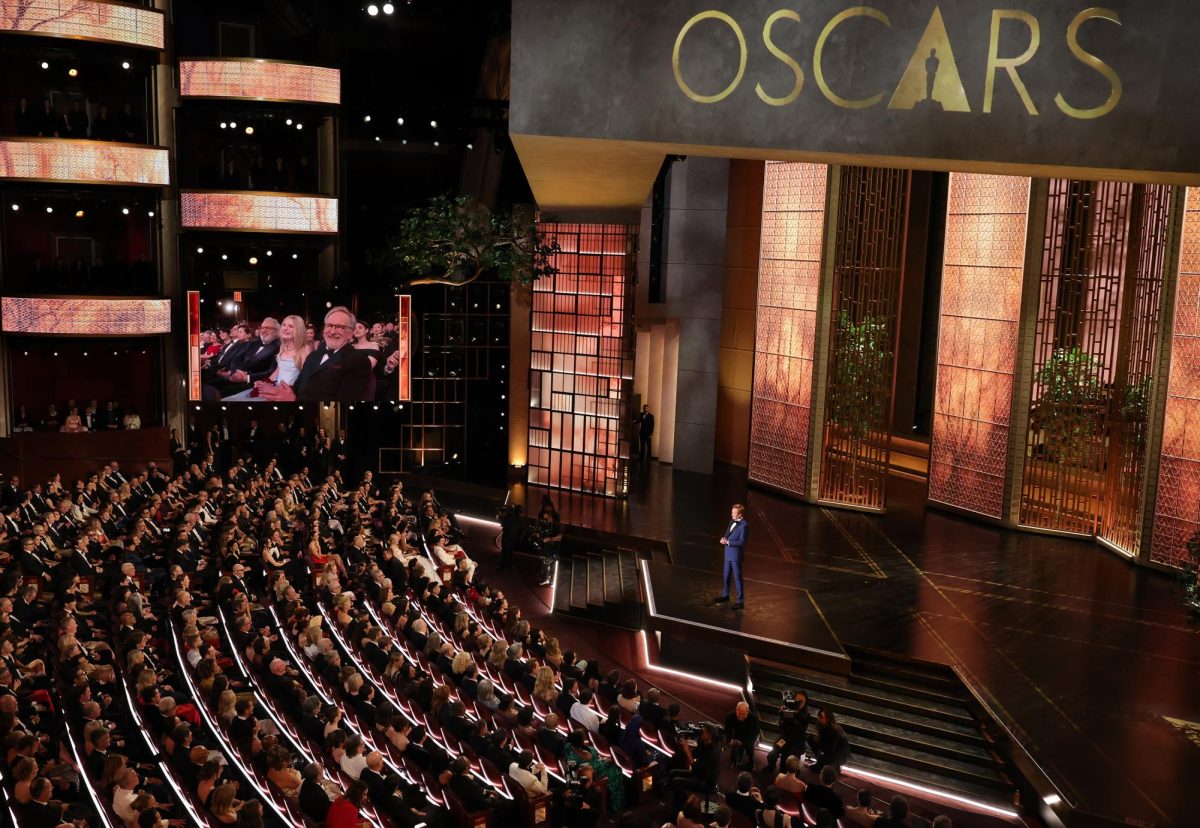


David Borenstein, co-director for the “Mr. Nobody Against Putin” documentary, won the Oscar for Best Documentary Feature on March 15. Borenstein was a Class of 2005 graduate from this school and left his mark by inspiring future filmmakers. Borenstein, along with his co-director Pavel “Pasha” Talankin, have created a memorable and inspiring documentary on the issue of government propaganda.
The documentary follows Talankin, who works as a teacher in the poor mining town of Karabash, Russia. The town is generally inconspicuous — other than its reputation as one of the most polluted places on earth — and is marked by characteristically-Russian, grey residential apartment blocks.
In the elementary school School No. 1 in Karabash, through recordings of his students, Talankin documented the Russian government’s efforts to control public opinion of the Russia-Ukraine War by distributing government-mandated patriotic education propaganda. The recordings served as evidence that Talankin was teaching his students the required material; however, he was also secretly sending the videos to Borenstein, which resulted in him later fleeing the country secretly in 2024.
Borenstein aptly described the movie’s political message.
“‘Mr. Nobody Against Putin’ is about how you lose your country,” Borenstein said. “You lose it through countless small little acts of complicity.”
Other than collaborating with Borenstein, Talankin undetermined propaganda in schools, often through comedic methods; he played Lady Gaga music instead of the national anthem. He also undermined propaganda through dangerous methods, like covering up patriotic symbols. Upon the film’s release, Russia unsurprisingly declared the teacher a foreign agent and banned the documentary from several streaming platforms.
However, the film is not without its critics. Many Ukrainians reportedly disliked the film because it humanizes ordinary Russians and creates a misleading narrative of Russians opposing the regime. They argue that Talankin’s documentation is not defiant, but complicit.
Interestingly, Borenstein specified that the movie serves as a warning flag for America.
“One interesting thing about working with a team of Russians throughout this process has been my desire as an American to constantly compare the situation in America to Russia,” Borenstein said. “But a lot of my Russian colleagues and friends always said, ‘No, no, it’s not the same situation. It’s actually happening quicker in America than it’s been happening in Russia.’ Trump is moving a lot quicker than Putin in his early years.”
U.S. Secretary of Education Linda McMahon defined patriotic education as a new priority for the Department of Education. An executive order by President Donald Trump issued on Jan. 29, 2025 declared that schools are dangerously ‘radical, anti-American’ indoctrination centers, instead preferring to embody American history as ‘inspiring’ despite its complicated past. This pattern is repeating in the U.S., as noted by Borenstein. In both cases, education becomes more about patriotism and nationalism rather than true history, erasing opposite viewpoints that are considered ‘anti-Russian’ or ‘anti-American’
A political angle is not new for Borenstein’s documentaries; in fact, they are a marker in his work. He has made various award-winning created documentaries, some of which expose the real estate market, the livestreaming economy and social media platforms in China. His documentary “Decoding COVID-19,” which covered the first six months of the pandemic, was awarded the duPont-Columbia Award.
Bornstein showed signs of excellence and creativity from a young age. He used to always write stories when he was younger. A teacher at Sawgrass Middle School predicted that he would win the Pulitzer Prize.
“I remember he was a good kid,” AP Government teacher Jeffrey Foster said. “He participated a lot.”
In the present, many film students have looked to Bornstein as a source of pride and inspiration.
“This story inspires my own film journey by reminding me that others in the same track as me are able to achieve the goals that they have worked so hard for,” junior and digital video technology student Jordyn Grant said. “Academy awards are things that I now don’t have to perceive as ‘far fetched,’ but instead as something that I can realistically attain.”
Students have felt pride for their school after hearing of Borenstein’s accomplishment.
“It really makes me proud of our great school and how much we were able to accomplish,” junior Kazu Hasegawa said. “It shows how it’s great that we have all these amenities, so we’re able to foster that kind of achievement.”
Borenstein’s Oscar win not only highlights the effects of propaganda in authoritarian regimes, but serves as an inspiration for young filmmakers.


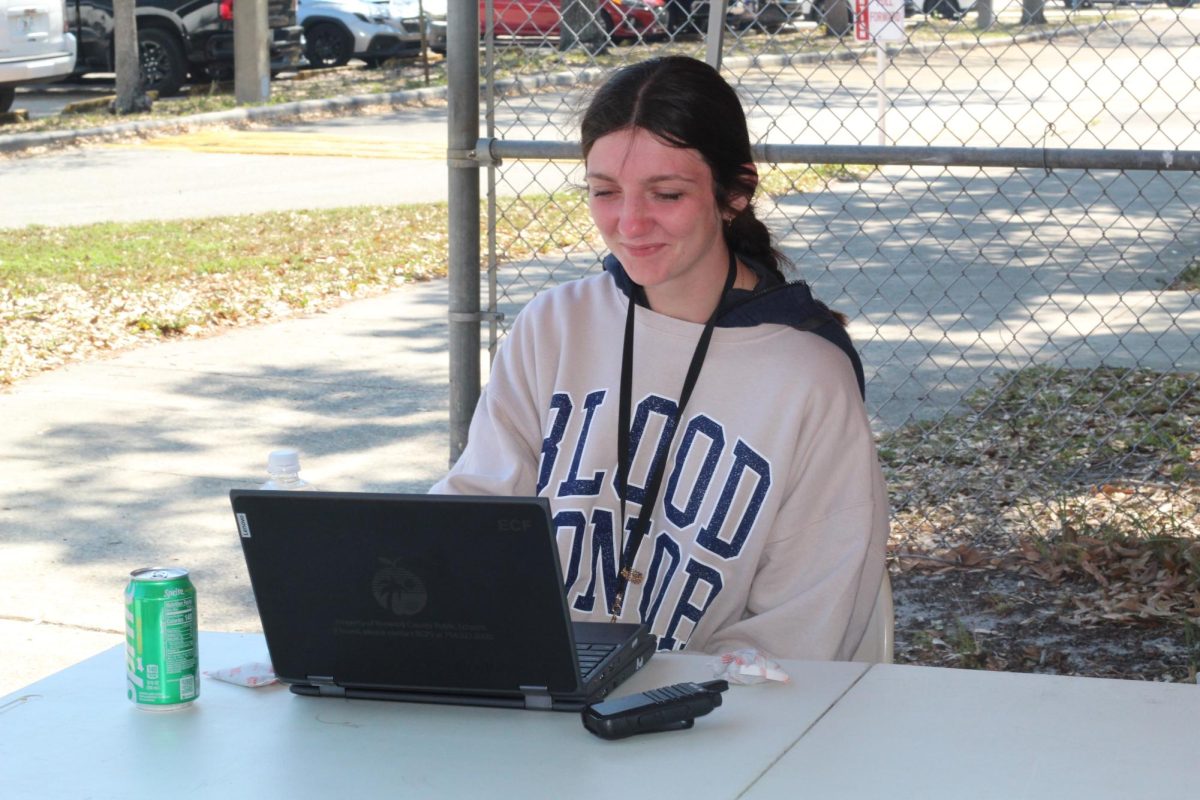
![Fruit Frenzy. Junior Kevin Miranda pushes a cart of fruit cups that are going to be put into breakfast bags. The bags were distributed during the First Responders Breakfast on the Day of Service & Love on Fri., Feb. 13. "I think we should always support our [first responders]," Miranda said. "They're the ones who put their blood and sweat into keeping us safe."](https://eagleeye.news/wp-content/uploads/2026/03/Nvbo42YAtJ4hkEIHrTSFTPVyOBiwB4qYlkuRQ9AL-1200x800.jpg)
![Get Sandy. Junior Nathan Borisoff sands down a wood pole in Marjory's Garden on Fri., Feb. 13. He and other students volunteered to renovate the garden on the Day of Service and Love. "I try to come out [to the garden] every Sunday, get that good work in, get in a workout and have a little bit of fun," Borisoff said.](https://eagleeye.news/wp-content/uploads/2026/02/sz0vKiapj8RtIimW3dY1eQ4BaWuJWnv2lAEdSmjV-1200x800.jpg)


![Pitch Perfect. Tenor and sophomore Aaliyah Anglade and bass and junior Juan Tejada prepare to sing during the Winter Concert on Fri., Dec. 12 in the auditorium. The pair was part of a larger group of the chorus that performed "Everything Red and Green" by Anita Cracauer. "[Rehearsals were] mostly just a lot of practices during class and listening to the song on repeat and being able to blend all of the different voices together, as well as a lot of after school practices for the small group song," Tejada said.](https://eagleeye.news/wp-content/uploads/2026/01/ka5Wcp44ZWpCZbdfZnnjQ022gSG59xO7cPYREETx-1200x800.jpg)




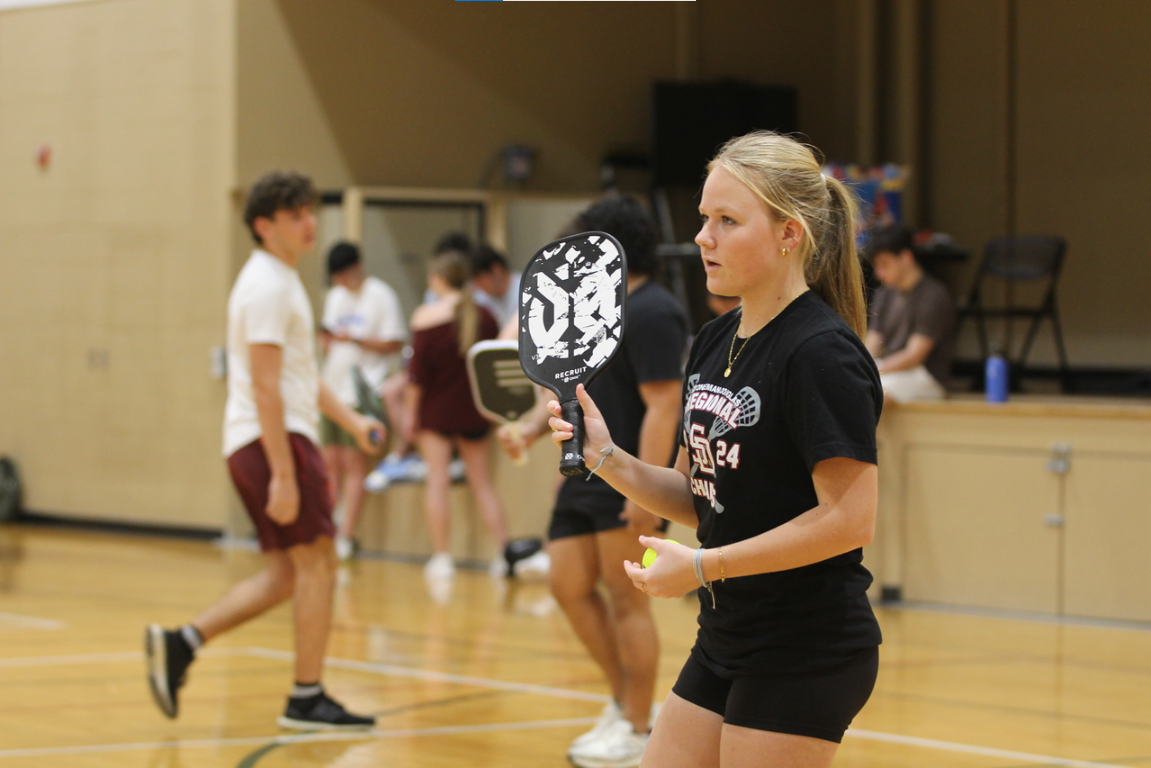






![Air It Out. Goalie Matteo Swetsky (16) passes the ball out of the defensive zone against Miami Country Day School on Thurs., March 26. It was a special occasion, as it was Senior Night, where the seniors were honored for their dedication to the men's varsity lacrosse team. "It was pretty sad seeing them [seniors] go," Swetsky said. "I had a lot of fun playing with them and hanging out with them this year."](https://eagleeye.news/wp-content/uploads/2026/04/kn9PDQ9bftlHl8ZyszGDNF5vKdUYiQoIcqXY4QLk-1200x843.jpg)



![Winning Streak. Baseball head coach Todd Fitz-Gerald receives a $1000 reward from the Orange Bowl Committee on Tuesday, Sept. 16. As part of the College Football Playoff Foundation's Extra Yard for Teachers program, Fitz-Gerald was recognized for his leadership, impact and commitment to the community both on and off the field. "I've enjoyed my time here [at MSD]," Fitz-Gerald said. "I coach baseball, I teach, I sometimes serve as administrator or security. But it gives me an opportunity to meet new kids and kids that you normally wouldn't meet in class, and gives a chance for me to build relationships. That's why I teach and coach." Photo permission from Orange Bowl committee.](https://eagleeye.news/wp-content/uploads/2025/10/ZVcVfwV3K1RQPOQ5TaC0lNv9JENixUa4orlwFHWj-1200x800.jpg)