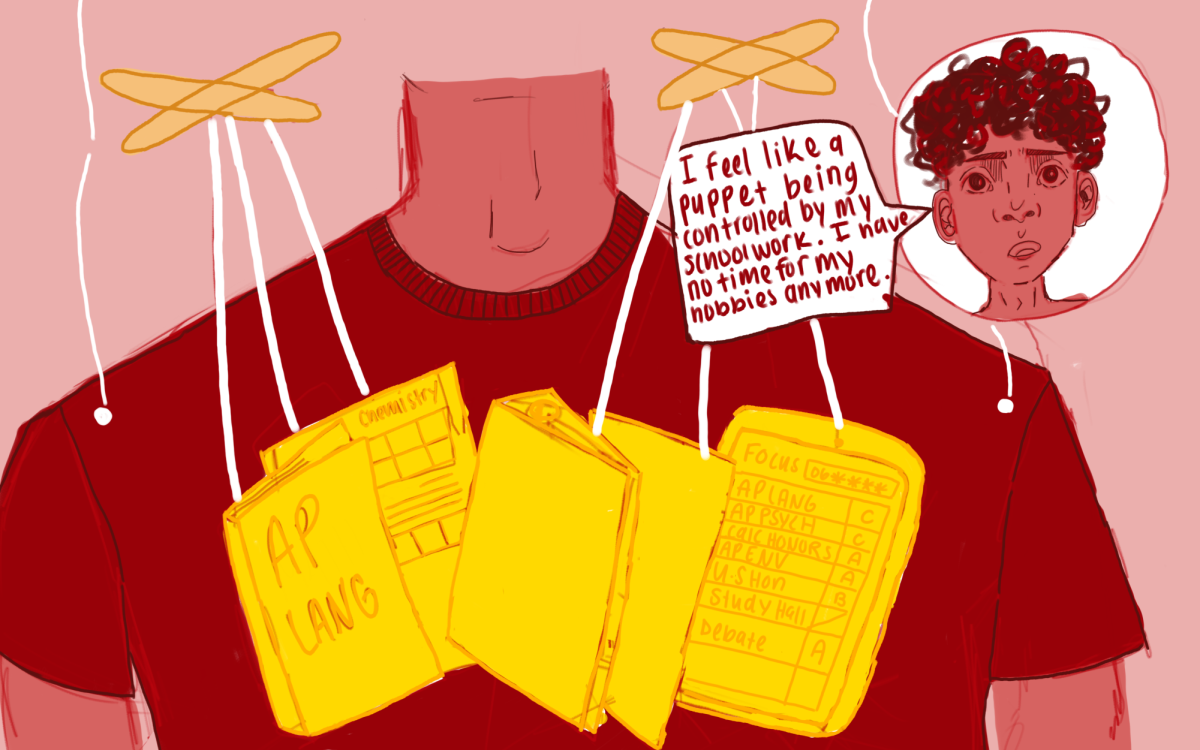


Teens want to hang out with their friends or use their extra time to explore new hobbies, but that is hard to do with piles of homework that need to be finished first. Students taking high-level courses and participating in multiple extracurricular activities to impress colleges leaves little to no time for much else.
In high school, students are expected to take on many classes to receive credits necessary to get into good colleges. Colleges expect to see that students have taken all these AP courses and were in high-level classes. With the pressure of trying to impress colleges students enroll in these classes but this also comes with a great deal of homework.
From this, the amount of homework starts to pile up and deadlines arrive quickly. Even if students are not taking harder level classes to prepare for college, there is still homework to do, and even if it is not as difficult, it can certainly be time consuming. Studying for upcoming tests and quizzes with tons of homework on top of that can be very stressful.
“The amount of homework I have combined with extracurriculars is really stressful,” freshman Olivia Zhang said. “My teachers are always giving out homework and most of them don’t even go over the things I got wrong. Some teachers just keep giving out test after test and I can not always keep studying every second of my day.”
In 2014, the Stanford Report stated that 50% of students found homework to be their primary source of stress. This can be alleviated by lessening the amount of homework as stress can have negative effects on mental health.
According to the National Library of Medicine, a study was conducted in 2022 that found that higher stress levels predicted increased anxiety and depressive symptoms over time. Mental health is serious and to prevent these issues, schools should put in place a maximum of four hours of homework a teacher can give a student.
Due to extracurricular activities and after-school events, students take a longer time to get home, cutting into the recommended sleeping hours for teens. Seventy percent of high school students in a CDC survey said they were not getting enough sleep.
Sleep is crucial — especially for students that are still growing — and sleep deprivation can lead to poor health. According to an article published in 2022 by the National Heart, Lung and Blood Institute, sleep deficiency is linked to many chronic health problems, including heart disease, kidney disease, high blood pressure, diabetes, strokes, obesity and depression.
“My son stunted his growth because of the lack of sleep he was getting; he was spending hours on homework,” biology teacher Billie Dollins said.
Too much homework can make a student incredibly busy and take away the free time that they have after school. This leaves less time for sports, hobbies and connecting with family and friends. Moreover, if someone spends all their time on homework and is unable to focus on the activities they love, it may become harder to improve and stay involved with all their interests.
“I have not hung out with any of my friends for two weeks now,” freshman Erielle Kogan said. “I have too much homework to do.”
Though some people may argue that having lots of homework is necessary for students to develop a better understanding of content, others, including teachers, do not agree with this sentiment.
“I feel that though homework is something that is very important to my students,” geometry teacher Lauren Bender said. “I try to not give them so much, knowing that they have other classes as well.”
In giving homework teachers should also be mindful about the fact that their students also have other classes. They should not give out an hour worth of homework when students are also receiving homework for other classes as well.
Although the excessive amount of homework is draining for all, the harm of increased school work is worse for financially unstable students.
Some children whose families are not financially stable may need to work a part-time job in order to help provide for their family. This can also reduce the time one has to complete homework as well as cut into sleep.
On the contrary, students who are from wealthier families find doing their homework much easier since they are more likely to have resources such as computers, internet connections, dedicated areas to do schoolwork and parents who tend to be more educated and more available to help them with assignments. Students who do not have access to such resources will find it even harder to complete their homework after school hours.
Excessive amounts of homework is proven to have a negative impact on students. Even though homework is helpful in helping students learn, giving them multiple hours of it every night is generally not good for teens.
Teachers can help to fix this problem by giving kids a smaller amount of homework that is best suited for helping them understand the material because students should not be working on their homework for three hours. An appropriate amount would be an hour a day or just enough to understand what they are learning.