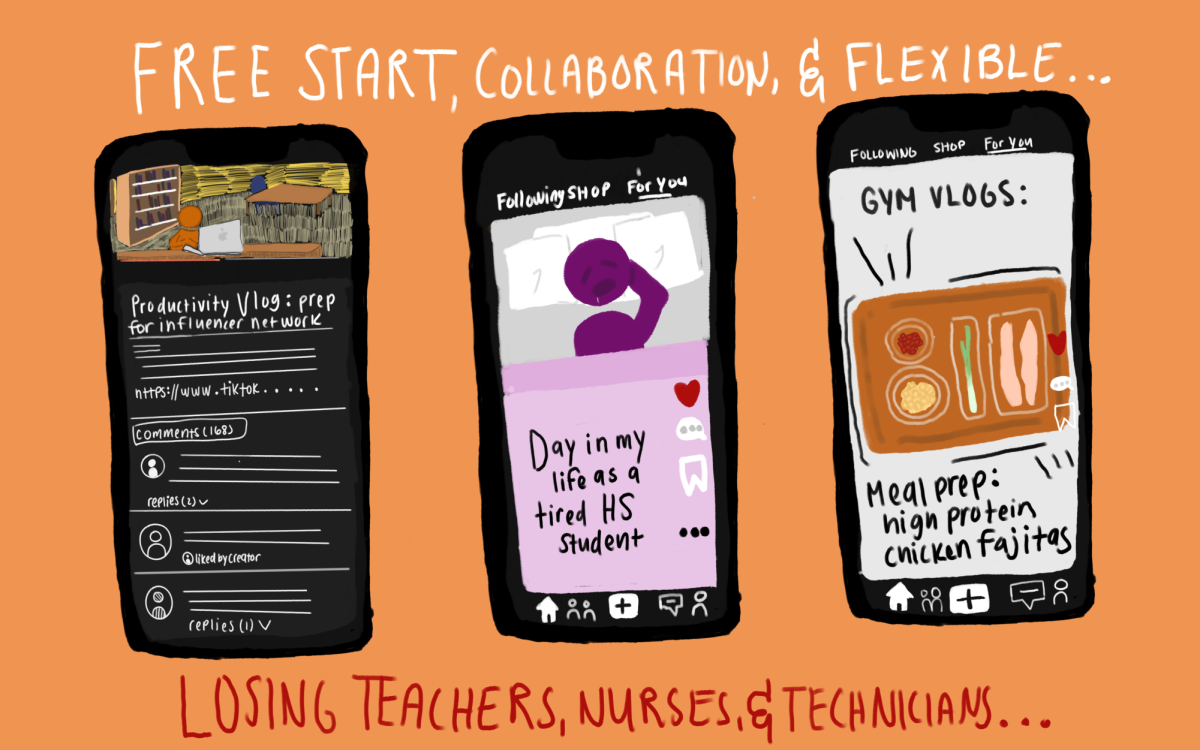

Becoming an influencer has, understandably, become the ideal career path for many young people today. In addition to the potential for fame and money, being an influencer allows people to avoid the strict hours and draining nature of a 9-to-5 job, as well as the college education and prior work experience requirements that come with them.
The responses of a 2023 Morning Consult survey, fielded from June 21-July 6, 2025 of 1,000 members of Generation Z (Gen Z), ages 13-26, revealed that 57% want to be influencers. However, the growing desire to become an influencer reflects concerningly upon societal values.
Society needs doctors and lawyers, teachers and social workers, firemen and construction workers — people to fill every undervalued yet necessary occupation there is. But more than that, society needs people who want to fulfill these occupations — who want to dedicate their lives to keeping others safe, protected, educated, fed, sheltered and much more.
Unfortunately, the majority of Gen Z would seemingly prefer to be an influencer than to commit to such careers. This can partially be attributed to the fact that society treats influencers as if they are of greater value than regular people with jobs out of the public eye.
Both the growing anti-intellectualism and cost of education in America reflect this, as do the poor pay and working conditions of those who hold the necessary jobs people deem average.
Being subject to the scrutiny so many influencers endure is by no means easy, but it also by no means negates the easy nature of the job itself. Influencers do not need to finish high school, nonetheless pursue higher education. Truly successful influencers make substantially more than the average person and can work from whatever location and in whatever conditions they desire.
College Board’s 2024 “Trends in College Pricing and Student Aid” relayed that the average annual cost of college for public four- year, out-of-state and on-campus undergraduate students — including tuition, fees, room and board, books and supplies, transportation and other expenses — was $49,080. The cost for public four-year, in-state and on-campus undergraduate students was $29,910. For all four years that is $196,320 and $119,640, respectively.
As of Feb. 2025, one in six American adults — nearly 43 million people — have federal student loan debt, according to Congress.gov. The inaccessibility of the education that is a prerequisite for most careers is a testament to society’s lack of regard for people who hold regular, yet necessary jobs.
Whether someone is a doctor or a teacher, prior education in one’s field is oftentimes necessary, and even when it is not necessary it is preferred. But not only must many in the workforce pay exorbitant costs to obtain an education, they must also cope with society’s growing lack of regard for education.
The 2019 Pew Research Center article “The Growing Partisan Divide in Views of Higher Education” reported that about 38% of American adults believe colleges and universities have a negative impact on the country. Meanwhile, the current administration repeatedly undermines education, cutting funds for the Department of Education and terminating and freezing billions of dollars in grants for universities.
Given the cost of and growing lack of regard for education in the United States, societal values seemingly undermine the pursuits of everyday people — people who are frequently required to have an education to obtain even a decently paying job.
This phenomenon is only furthered by the unsuitable wages and working conditions many endure. The 2019 Brookings research article “Meet the low-wage workforce” reported that 44% of all American workers, ages 18-64, earn low hourly wages. Meanwhile, poor working conditions in the U.S. remain pervasive.
A career as an influencer in many ways means safety from the misfortunes society affords those in the workforce. Consequently, the prevalence of the desire to be an influencer speaks volumes about how the average worker is treated. If society began to value every person in every type of job, people would feel more inclined to pursue a career in the field they would like as opposed to a career as an influencer.
This story was originally published in the January 2026 Eagle Eye print edition.